Header

Wednesday, December 31, 2014

The Science of Weather by Eileen Hynes

Windsocks in the Upper Primary Classroom. 
The children at Lake and Park spent the month of December engaged in careful and systematic observation of the weather.  Weather affects us all. It informs what clothes we wear to school, if we bring boots or not, or even what games we play at the park.

In the summer of 2014 I applied for a grant through the NOAA Climate Stewards Education Program.  I had begun working with the Climate Stewards the year before, participating in monthly Webinars with national and international scientists, and monthly regional meetings to discuss science and climate education with other teachers. 

On January 13, 2014 Peg Steffen, of the National Ocean Service, presented a talk titled “Misconceptions and Conceptual Change”.  Prompted by recent research on student misconceptions as well as the desire to improve science education in the United States she informed us that. “A new study finds that what's especially critical to improved science learning is that teachers also know the common misconceptions students have.”

 At Lake and Park teachers work collaboratively to provide relevant and accurate thematic studies which address both student questions and their scientific interests.  Common misconceptions, according to Stephen include:
 • That weather and climate are the same   • That the sun goes around the earth
• Seasons are caused by the Earth’s distance from the Sun.
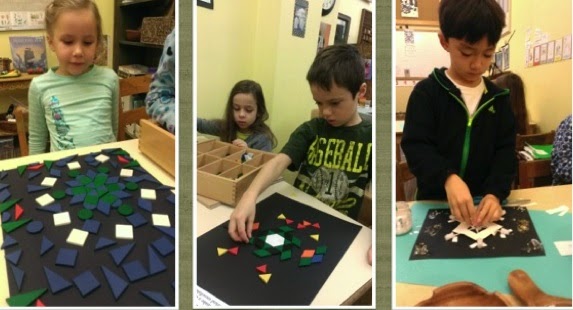
Primary students explore snowflake designs with the Frobel materials.

As it turned out, December was the ideal month for us to focus on these misconceptions.  The Beginning Class moved into a study of Space inspired by the Native American legend, “ Her Seven Brothers”, retold and illustrated by Paul Goble.  The students learned about major star constellations, the planets in the earth’s solar system, and the important role the sun plays.  Through poetry, music and dance the children acted out the planets spinning in the solar system, orbiting around the sun.  As each child in turn played the role of the sun, they stood firmly fixed in one position as other children went spinning around them.
Students gathered weather data daily.


The Primary, Upper Primary and Intermediate Classes began keeping weather observation charts on December 1.  The goal was to have students record the daily temperature over a period of weeks and then graph the data alongside data provided by the National Weather records that show daily averages for the same period of time.  This task was a concrete way to engage students in understanding the difference between weather and climate.  Along the way many other topics and interests were discussed and discovered.  Every class read many books on related weather topics, including Stars beneath Your Bed: the Surprising Story of Dust, by April Sayre, and Weather and Climate: How Weather Works, by Robin Birch.


Journal entry.
The hydrologic cycle, or water cycle, was discussed and
illustrated throughout the grades. Many
students played a water molecule game to experience the various forms water takes and to understand that water cycles through the planet in many different ways.

With temperatures the first few mornings of December greeting us at -3 or -4 Celsius, the Primary Class quickly became focused on the formation of ice crystals. They asked each other questions about how the ice forms, and how the crystals attach to each other. They were introduced to the concept of ice core research; this raised many more questions about how scientists know: for example, how our knowledge of paleoclimate is based on ice core studies. The Primary Class will be touring the ice core lab at the University of Washington in January and meeting with scientists there. As part of this unit the primary children learned about the geometry of snowflakes, They built sculptures out of ice inspired by the art of Andy Goldsworthy, and  read about Yupik and Inuit people who call the far northern regions home.


The Upper Primary Class took daily walks as part of  honing one of the major skills of meteorologists throughout history, that of observation.  As they practiced using their senses to observe and then worked to translate these observations into weather reports, the students began to fine-tune their observations, building vocabulary to more accurately express what they were seeing and feeling.  Why are clear days in the winter colder then days with more cloud cover?  Can we tell which way the wind is blowing?  This group wrote winter haiku, experimented with pinwheels, and created windsocks.


Students at all levels worked to collect data and then graph that data and analize it in a meaningful way.


The Intermediate Class worked extensively with data during December; both weather data collection and graphing, as well as tracking and comparing the varried journeys different water molecules made through the water cycle. The complexity of the questions being asked increased throughout the month. (Further research and investigation into what makes wind and how clouds change shape will be included in ongoing studies.)  The Intermediate Class looked at a graph of the average temperature in the US over the last one hundred years, revealing that a warming trend is occurring over extended periods of time.  Students worked together to explain the role the tilt of the axis plays on earth’s changing seasons and we acknowledged the approaching winter solstice.
Students worked to understand various components of the weather
 station through drawing. 


During the last week of class before winter break, students were introduced to the school's new weather station.  Having collected data using thermometers and sensory observations students were excited to figure out what data each component of the weather station was designed to collect.  Everyone agreed collecting data in January was going to be much easier with our new equipment.  Students in the Upper Primary Class and the Intermediate Class will be visiting the NOAA National Weather Station in Seattle in January to learn from the scientists working there about weather data collection, forecasting and other careers in related scientific fields.


The three major misconceptions identified by Peg Steffen were addressed in various ways throughout the classes at Lake and Park, all during the month of December.  Because each of these concepts is complex,  students’ understandings will continue to shift in and out of focus and grow in clarity as children and knowledge both develop.  The confidence a child has in his/her own ability to think and reason scientifically is established through the kinds of activities and discussions that we engaged in so actively this month.  Such activities play a key role in bringing clarity to complex realities.  As Chloe said after she raised her hand to share an explanation with her class of why it is colder and darker in the northern hemisphere in December, “I know I know this!”  and she did.

Wednesday, August 13, 2014

Summer Camps at Lake and Park School and What They Offer

Each year when the school year is officially over we host our week of school’s out/ summer’s here Transition Camp. This is a special weeklong experience that is exclusive in its audience: only open to children who have attended Lake and Park at some point in the past. The reason being? Because we are all just as comfortable as can be—kicking off our shoes, so to speak, and just being together. Boys and girls from across the grades spend whole days together. Camp begins at nine and ends at five but children want more when five o’clock rolls around. Often Transition Camp begins with breakfast, making this “home away from home” cozier still. Toast and jam and cold cereal is served long into the morning. Children engage in Lego play while others read comics, still others draw and another group works with the Big Blocks. Transition Camp truly is the bridge between school and the vacation that is just around the corner.

This year’s highlights were many, but some that stand out for me:

Everyone downstairs on the last day of Transition Camp enjoying an ample pancake breakfast while the Trike Room was the scene of roller skating and skate boarding. We all watched an impromptu talent show as children showed off their newly acquired or recently honed skills. Children helped with cleaning up the “restaurant” at the end of the pancake breakfast—a meal that went on all morning. Quynh and Tom kept the grill hot. Autumn Taylor Roff found her niche in working with the dishwasher and taking last minute orders, true restaurant style. Clare Conrad and Lee Seese from the church office joined in when new customers were sought after.

At the very end of the very last day I think fondly of Quynh’s lovely reading of Rosemary Well’s little library called The Bunny Planet. A fictional account of rabbit children getting a retake on days that had not gone so well, our children’s amazing scope of knowledge came out strong as children provided similes for the repeat experience: time warp, black hole, alternative reality!


Puppy Camp

The following week we welcomed Kathi Titus and her colleague Mary as they shepherded four dogs up the stairs each morning. Children new to Lake and Park joined with us in learning the basics of puppy training. By the end of the week, children were showing their prowess at getting dogs to sit, come, heel. The interaction between children and animals is a powerful thing to observe; this week long focus allowed children ample time to interact with the dogs.
 

Chaucer Camp

In the afternoons, Grant and I opened the North Room doors to the medieval world of Chaucer’s tales. After learning about the construct of the tales—a trip from an inn to a sacred shrine at a cathedral several days hence and back again—we looked into the Pardoner’s Tale as our beginning point. Art projects and free play in block building as well as a “full on” knightly tournament added to our understanding of the tales and times. On our final day, we simulated the role of pilgrims by entering into the church sanctuary—a perfect place for Thomas Becket’s shrine. Upon leaving, we were wearing the traditional pilgrim cockle shell. We then walked to our own Tabard Inn (Tutta Bella) in Columbia City. After feasting we ended our time together at the Columbia City playground. Several of our group—Rose and George— are actually journeying to Canterbury Cathedral in August; we hope they let us all know about it on their return.


Backyard Games

The following week, we again offered a morning and an afternoon component. Grant and I worked once more as a team throughout the day. In the mornings we engaged a group of children in learning all kinds of backyard games. Grant taught a game called Danish Rounders which offers beginners a way to learn how to engage in the basics of organized sport. Particularly apropos of kickball and baseball, it teaches how to run the bases in a way that allows each child to proceed at her/his own speed. We played hide and seek and sardines, its inverse, sardines. We learned to play hopscotch and made our own on the patio. It came to our attention that hopscotch began as an exercise that the Roman Legionnaires undertook to keep agile and light of foot. They performed wearing armor. A highlight for both of us as teachers was to see how the youngest children were able too join in to teacher directed games with such ease. One morning, while spending time in the Mount Baker Park meadow grasses, we gathered for a quiet break and watched a butterfly make its rounds among us, landing on Harper again and again.


Backyard Creatures

In the afternoons, a final camp was held—Insects and Other Backyard Creatures. We took the time to take a close look at those small animals that live among us—worms and spiders, ladybugs and bees. We used Christina Rossetti’s poem as a touchstone for the class. We learned about animals in order of their complexity—from the simple earthworm to the to the arthropod. Several highlights have to be mentioned: Ardin’s mother gave us six boxes of ladybugs which we released one happy afternoon at Triangle Park. Ted made a “ladybug playground” for them from found objects; children young and old worked together. While learning about spiders, we read Anansi folktales from Africa. (A trickster character, children compared him with other tricksters they have known: Hermes, Loki,Bre’r Rabbit, Coyote, Raven. We acted out the story of Anansi and the Moss Covered Rock. Each child participated in our impromptu theater, each one making a signifiant contribution through drama to all of us watching the performance. We ended the week at the Butterfly House at the Science Center, Tom joined us for this culminating field trip where we looked at butterflies and many other insects with the understanding that our week’s study afforded us.


Hurt No Living Thing

Hurt no living thing,
Ladybird, nor butterfly,
Nor moth with dusty wing,
Nor cricket chirping cheerily,
Nor grasshopper so light of leap
Nor dancing gnat, nor beetle fat,
Nor harmless worms that creep.
Christina Rossetti