Header

Friday, May 1, 2015

Thematic Studies - Unit of Inquiry: Mountains - by Andy Gregory

"The mountains are calling and I must go." - John Muir

Students at Rattlesnake Ridge take time to contemplate how the landscape was formed.

At the beginning of last week we wrapped up our mountain unit in spectacular fashion, with an incredible display of art, science, and pure joy as we created our own Ring of Fire at Mt. Baker Park.

The Ring of Fire
Although each classroom approached this grand unit of inquiry in its own unique way, the whole school participated in many events that bridged the gap from small to large: rocks and minerals to mountains and volcanos, topography and cartography to plate tectonics and seismology.

Many of us began by learning about the three types of rock: igneous, sedimentary, and metamorphic, and discussing the differences in how they are formed over time. A sense of wonder often filled the hearts and minds of our young learners as they thought about rocks being either formed by hot, volcanic processes or eroding over thousands of years by the forces of weather, water, time, and pressure. A fascination with crystals led many of us to study how they are formed. Lists and drawings of familiar rocks and minerals were made, while new ones were discovered and catalogued.

Students analyze and paint rocks and crystals.
Our wonderings led us into the center of the Earth. As we learned about the inner core, outer core, mantle, and crust, we talked about the scientists who made these discoveries about our planet and wondered about how our surface can be so cool (comparatively) when our inside is so hot. Coupled with our earlier exploration of clouds and the Earth's atmosphere this year, we investigated the language and science of the layers of our planetary bubble, from the inner core to the exosphere.

A layered diagram of the Earth and its atmosphere.
We looked at topography as well, studying the concepts of contour lines and the logic of plotting lines on topographic maps. Some of our young cartographers made maps of their own.

Students make topographic maps.
While studying our local mountains, some of us went on field trips to places with excellent views of the Olympic and Cascade ranges. We spent time identifying specific peaks, painting landscapes and learning about the natural history of the Pacific Northwest.

Moving towards larger scale Earth processes, we delved into plate tectonics and subduction, learning about the plates of the world. We specifically took a look at the Pacific Plate, the North American Plate, and the Juan de Fuca Plate, the actions of which have largely constructed our local mountains and volcanos over time. 

Boom!
When it was finally time to end our exploration of mountains, the could have been no more fitting end to the unit than our day together as a school at the park erupting our volcanos. It was also fitting that Earth Day was in the middle of the week, acting not only as a great day of mindfulness and intention in relationship to the Earth, but also a wonderful transition between our mountain unit and our new unit on sheep and wool. 


Keep close to Nature's heart... and break clear away, once in a while, and climb a mountain or spend a week in the woods. Wash your spirit clean. -JM

Thursday, April 30, 2015

Earth Day Fair 2015

Planet Earth Collage - "I hope the earth doesn't get destroyed"
Lake and Park School Earth Day Fair of 2015 was a day of active participation, peer teaching, and shared experience.  The morning began with a community meeting led by the school founder and director, Camille Hayward.  To create an Earth Day Song Book, the oldest students in the school had generated a long list of songs we all know which relate to many of our studies over the years.  Our singing that morning was enthusiastic and earnest. The week before, North Room students worked on a special edition of the school newspaper.  Each person had chosen a topic based on personal interest, class studies and relevance to a special “Earth Day” edition of the paper.

Morgan Padgett, the Primary Class teacher opened the gathering with a beautiful poem by JaneYolan, setting the tone for a wonderful day of exploration, learning, connection and celebration of planet earth.
Morgan reads Earth Day, by Jane Yolan
I am the Earth
And the Earth is me.
Each blade of grass,
Each honey tree,
Each bit of mud, 
And stick and stone
Is blood and muscle, 
Skin and bone.

And just as I 
Need every bit
Of me to make
My body fit,
So Earth needs
Grass and stone and tree
And things that grow here
Naturally.

That’s why we 
Celebrate this day.
That’s why across
The world we say:
As long as life,
As dear, as free,
I am the Earth
And the Earth is me.
Over a dozen different activities were planned for the fair and students moved throughout the school with a certificate to record participation at each activity.  The oldest students had planned together a variety of different events to teach and focus attention on this special day, with pairs of students organizing and supporting each area.  In this way, the fair reflected the scope of learning that began last fall with our all school study of weather, and continued throughout the winter with a focus on energy use, and learning about many of the earth’s systems.  The variety of activities also engaged many different modalities of learning; game playing, art, writing, experimentation, and construction. The focus was on re-using materials.
Roham works to create a game that teaches about garbage in preparation
of the Earth Day Fair.
Planting seeds.
Testing recyceled boat construction.
Sharing the special Earth Day edition of the Lake and Park Times.
Writing Earth Day Poetry.
Making Earth Day flags.
Map making at the easels.
Playing the recycle game,
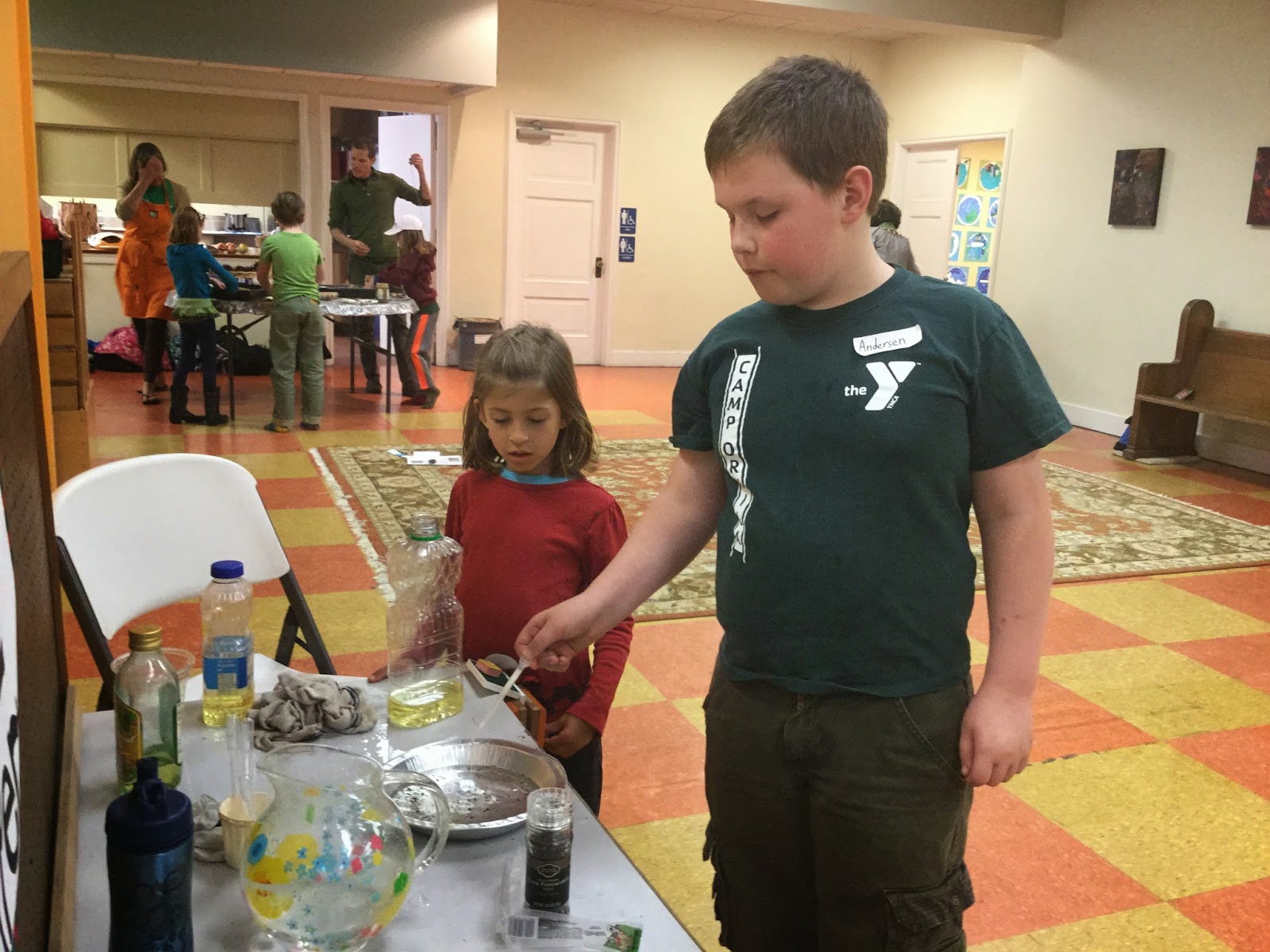
Investigating oil and water.
Learning about bike to school month.
Ready to clean up the neighborhood.
Making bird feeders.
Water testing at the salmon tank.
Recycled paper collage.
Friday, May 1, marks the beginning of Bike Month.  Some students and teachers will ride bikes to school. Other students will ride to afterschool activities, or around the neighborhood. Not everyone has a bike-friendly commute to school, but we hope every family will talk about ways to conserve energy.  One ongoing focus of the Earth Day Fair is learning about the Carbon cycle and the role humans play in contributing to an imbalance in the cycle, which leads to a warming planet.  The fossil fuels we use to provide energy in the form of gasoline and electricity are releasing more carbon dioxide into the atmosphere than the planet can absorb and recycle in a healthy way.

Working with our wonderful educational partners in the community; National GeographicEducation, Facing the Future, EarthEcho International, NOAA Climate Stewards, and Friends of the Issaquah Salmon Hatchery, students across the grades are learning and thinking about the ways the earth’s major systems work, and the ways people interact with these systems. Earth Day 2015 was a day to celebrate this learning.  We hope families will let us know when and how you take action at home to reduce energy use. Ask your child about it, they may have some ideas.   In all, the group effort of dedicated students and teachers made the Earth Day Fair a meaningful and engaging event for everyone. 
The whole school gathers at the end of the day to share poetry and song.